

Being a suspect in a criminal case - what to expect

Who is a person suspected of an offense, a suspect, and an accused?
If there is a suspicion that you may have committed an offense under Polish law, it is worth first establishing your procedural status. This is of key importance for the rights and duties available to you.
- A person suspected of an offense (osoba podejrzana) - someone against whom there is a suspicion of having committed an offense, but who has not yet been formally charged. They are not a party to the criminal proceedings.
- A suspect (podejrzany) - a person against whom a decision to present charges has been issued, or who has been questioned in that capacity. From that moment, they acquire the status of a party to the proceedings.
- The accused (oskarżony) - a person against whom a bill of indictment has been lodged with the court, or in respect of whom an application has been made for conviction without a trial, or for the conditional discontinuation of the proceedings.
It is worth remembering that not every person suspected of an offense becomes an accused. Proceedings sometimes end at the pre-trial stage.
The stages of criminal proceedings, step by step
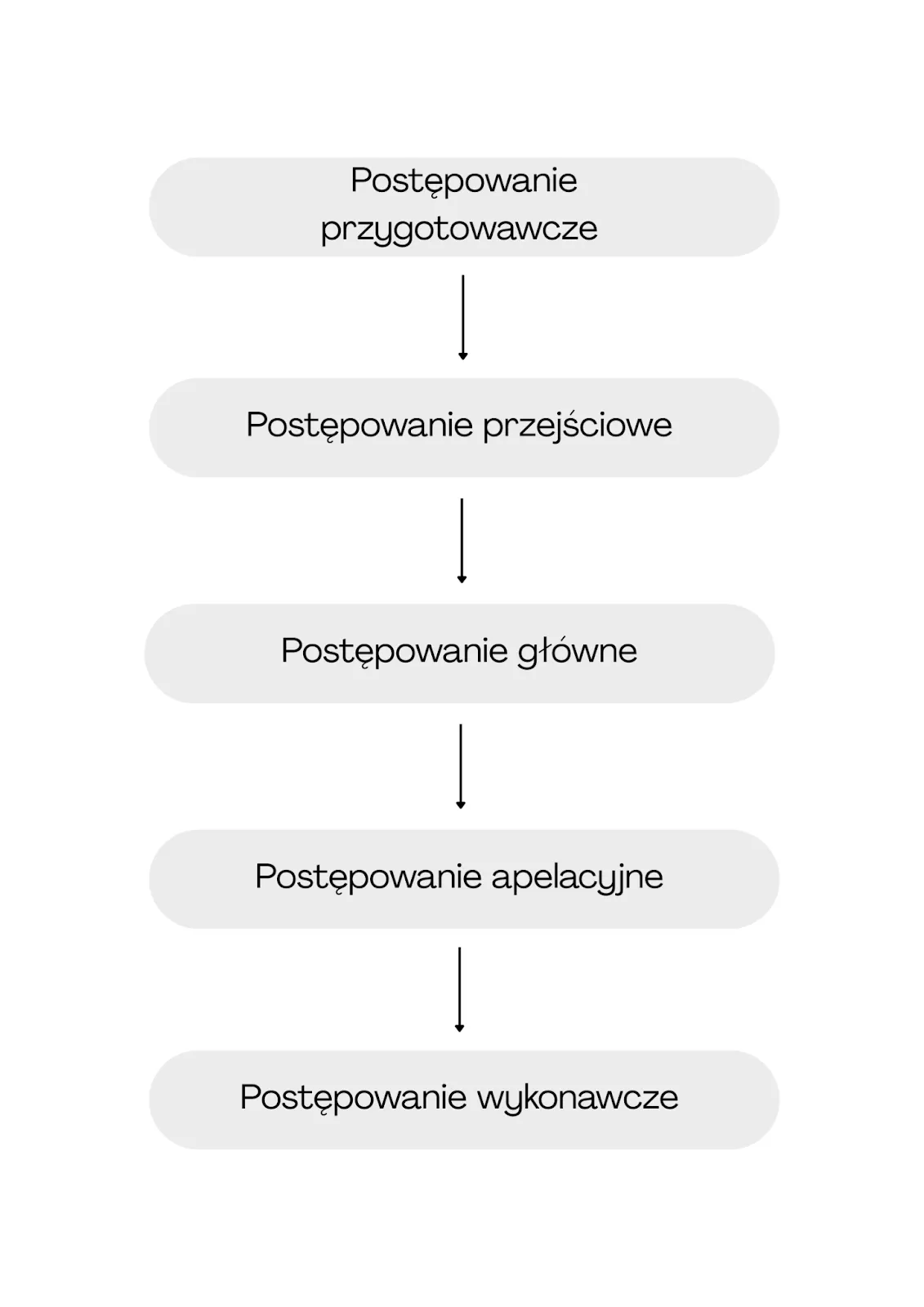
The stages of criminal proceedings
(diagram in Polish - stages of criminal proceedings: preparatory, intermediate, main (trial), appellate, executive)
The diagram above shows a graphic representation of the typical course of criminal proceedings in Poland. Various other configurations are of course possible that the diagram does not capture.
Stages at a glance:
- Pre-trial proceedings (postępowanie przygotowawcze)
- Intermediate proceedings
- Main proceedings / trial
- Appellate proceedings
- Enforcement proceedings
The whole procedure begins with the pre-trial proceedings, which serve three functions. The most important of these are:
- The preparatory function, which consists of gathering and recording the evidence on the basis of which the prosecutor will decide whether there are sufficient grounds to lodge a bill of indictment.
The remaining two are ancillary:
- the preventive function and
- the quasi-prejudicial function.
Pre-trial proceedings can take the form of an investigation or an inquiry, both of which carry equal legal status. The model of pre-trial proceedings in force in Poland is based on the Soviet-era approach, under which the investigation is reserved for more serious or complex cases, while the inquiry is used for less significant ones.
Pre-trial proceedings are divided into proceedings conducted in relation to the matter (in rem) and against the suspect (in personam). Proceedings in rem begin when a decision to open an investigation or an inquiry is issued or - in cases that cannot be delayed - when procedural steps are taken, to the extent necessary, even before such a decision has been issued, and last until a decision to present charges is issued, or until the questioning of a person as a suspect begins. Proceedings in personam, by contrast, begin at the moment charges are formally presented, or the questioning of a person as a suspect begins.
The presentation of charges
The moment charges are presented, the pre-trial proceedings in personam begin, and the person acquires the status of a suspect. The presentation of charges consists of the following steps:
- Drawing up the decision to present charges. It must identify the suspect and give a precise description of the act alleged and its legal classification.
- Communicating its content to the suspect without delay, and informing them of their rights and duties.
- Questioning the suspect, unless this is not possible. It is worth remembering that questioning is not permitted before the decision has been communicated to the suspect, unless one of the exceptions provided for by law applies.
- Informing the suspect of the right to request, until they are notified of the date for reviewing the investigation file, that the grounds for the charges be given to them orally, and that a written statement of reasons be drawn up.
- Drawing up that statement of reasons and serving it on the suspect and any appointed defense counsel.
The conclusion of pre-trial proceedings
Pre-trial proceedings can conclude in the following ways:
- A bill of indictment being lodged with the court.
- An application being lodged with the court for a conviction to be handed down at a sitting, imposing penalties or other measures agreed with the accused.
- Discontinuance of the investigation or the inquiry.
- Discontinuance of the inquiry and entry of the case in the register of offenses.
- An application to the court for the conditional discontinuation of the proceedings.
- An application to the court for discontinuation of the proceedings and the imposition of security measures.
FAQ
1. Can I be unaware that I am a person suspected of an offense?
Yes. A person suspected of an offense is not formally informed of their status, since they are not yet a party to the proceedings.
2. Am I obliged to appear when summoned by the law enforcement authorities as a person suspected of an offense?
As a rule, yes - if the summons states that your attendance is mandatory. The summons specifies in what capacity you are being summoned (most often as a witness), whether you must appear, and what the consequences of failing to appear are. Failing to appear without a valid excuse may result in a procedural fine, and even in your being detained and brought in by force. Before you appear, it is worth consulting an advocate.
3. When is it worth seeking the help of an advocate?
As early as possible. Even as a person merely suspected of an offense, you may need support to avoid worsening your procedural position.
This content is provided for general information only and does not constitute legal advice.
See also
Shortening a penal measure - when is it possible?
When Polish law allows the term of a penal measure to be shortened, and how to apply to the court for it.

Management board members' liability for a company's debts
A management board member's liability for a company's debts under Polish law - when personal assets are at risk and how to avoid it.

Conditional suspension of a sentence - what you should know
Conditional suspension of a custodial sentence under Polish law - who can rely on it, and what conditions must be met.